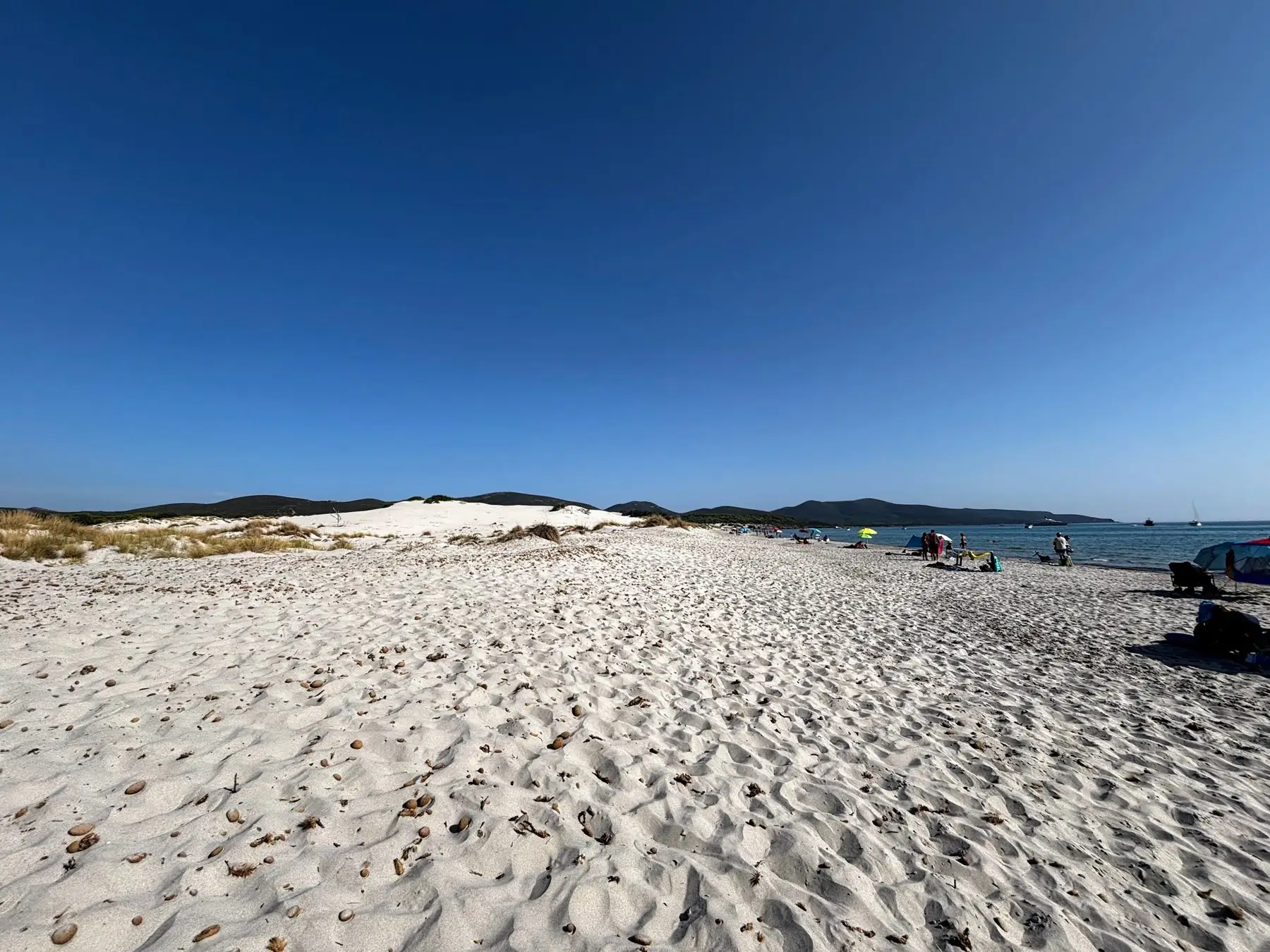
The coast road, all the way to Tuerredda
SP71 Costa del Sud · 25 km along the sea · from the village to Tuerredda, unhurried
-
The route
The SP71, the Costa del Sud
This is what the day is about: not a beach with a drive in front of it, but twenty-five kilometres of road hanging above the sea that end at Tuerredda. The Costa del Sud is one of the finest stretches of coast on the island and it changes colour at every bend. From the centre you drop down to the SS195 and join it heading east, towards Chia: that way the sea stays on your right and all the scenic lay-bys fall on the right side of the road.
Allow twice as long. It's about twenty minutes from the house to Tuerredda if you drive straight there: but if you do the road as it deserves, stopping along the way, it takes an hour. That hour is better spent than an extra hour on the sand.Today you do not stop at the coves. the cove at Larboi and the beach at Piscinnì open up along this same road, but they have a day all to themselves: today you only look, to work out where to come back to tomorrow. -
First stop
The Torre del Budello
The first view over the harbour bay, with the Spanish tower on top of the headland. Ten minutes is enough: it is only there to show you how this coast is put together. You will find the same view again later in the week, with the sun low and a glass in your hand.
-
Where the road ends
Tuerredda
The road crests one last time and there it is below you: half a kilometre of pale sand between Capo Malfatano and Capo Spartivento, with the islet planted just offshore, a few minutes' swim away or reachable by pedalo. This is the beach people come all this way for, and it lives up to its reputation: calm water, sheltered from the strong winds, a clarity that doesn't fade even in August, a rich seabed. The mask-and-snorkel beach of the area. Kiosks, hire places, plenty of parking — you stay here for as long as it lasts, this is the place where it makes sense to lose track of time.
The beach rules: a beach mat instead of a towel is compulsory, no dogs, no smoking, no tents. You show the booking QR code at the entrance. -
Heading back
The same road, the other way round
Don't rush back: the SP71 on the way home is a second route, not the same one in reverse. In the late afternoon the colours of the coast change completely, the lay-bys you skipped on the way out are empty, and the sea, with the low light behind you, does what it never does at midday. Then dinner in the village, a couple of minutes from the house.
The cove at Larboi and the beach at Piscinnì
Two stops close together on the same coast as yesterday · today, though, you do stop
-
Before you set off
Lunch is put together in the village
This is the right day for a packed lunch, and it is worth doing it properly. In the village you will find fresh bread from the bakery — soft-crumbed civraxiu, or pistoccu if you want it crisp — and at the grocery shop Sardinian pecorino, cured sausage and tomatoes. Two rolls made like that, eaten in the shade of a juniper with the water in front of you, are worth more than any booked table.
Bring your own shade, too. They are two small coves with no kiosks: a beach umbrella, cold water and a hat are sorted out before you set off. It's the only bit of forethought you need, and it pays off all day. -
The first one you come to
The cove at Larboi
You take the coast road towards Chia and, after a few bends, an open patch of ground appears on the right where you leave the car. From there you go down into a snug little cove, closed in by rocks and vegetation, with water that holds emerald green and turquoise together. The sand is white and coarse-grained, the sort that doesn't stick to you: you come out of the water and you're already clean.
The right spot when the wind is up. Larboi is well sheltered, and it stays quiet even on the busiest days in August: it's small, so people driving past often carry straight on without noticing it. Medium-to-shallow seabed, sand mixed with smooth pebbles. -
A little further on
The beach at Piscinnì
You set off again and within a few minutes, carrying on towards Tuerredda, you reach Piscinnì. Here the sand is white and very fine, and it gives the water a clarity that stands comparison with any beach on this coast: you can stand up tens of metres out and count the stones on the bottom. A few rocky outcrops form small natural pools, and the two headlands covered in Mediterranean scrub and sea lilies close in the bay on either side. It's also the best place in the area for mask and snorkel: there are fish here, and you can see them.
Above and behind the beach. On the headland stands the Piscinnì tower, sixteenth-century, reached by a short path; scattered around it are the traces of the Roman sandstone quarries, from which the stone was shipped out by sea. Behind it there's a lagoon and the dune system is being restored: the area is marked off with posts and you stay outside it. -
How to do it
One, or both
They're a few minutes' drive from each other and the two work perfectly well in the same day: Larboi in the morning, when the sun is still low over the cove, and Piscinnì in the afternoon, when the people who have been there since morning start freeing up parking spaces. But if the first one wins you over, stay put: the second is ten minutes from the house and you can go back whenever you like.
The Americans' cove, S'Ortixeddu
From Teulada to the harbour and then the dirt track · rounded off with drinks on the quayside
-
Setting off
From Teulada to the harbour, then the dirt track
Not much driving today: from Teulada you drop down to the harbour, ten minutes, and from there you take the dirt track towards Portu Tramatzu, carrying straight on along the main track. The first car park you come to is the one at S'Ortixeddu — another five minutes, and you're there.
Buy lunch before you head down. As with the Larboi and Piscinnì day, it's worth calling in at the bakery and the village grocery shop: fresh bread, pecorino, cured sausage, a bit of fruit. There are no kiosks here, and with a couple of properly made rolls the day stretches into the afternoon without having to drive back up. -
Where you end up
S'Ortixeddu
A small cove, closed in by two rocky headlands, with white sand and a shallow, sandy seabed that stays clear for a good many metres from the shore. Everyone calls it the Americans' beach, after the soldiers who used it over the years from the military range, and the name has stuck. It's the right place for a lazy day: you arrive, spread out your towel and need nothing else.
It's a small cove. It doesn't hold many people, and that's part of what makes it: get there early and you'll have it almost to yourselves, with room both on the beach and in the car park. Beach umbrella and cold water come with you from the house. -
In between
The two headlands
The rocky ridges that close in the cove on either side are the most interesting part: with mask and snorkel, along their edges, you'll find far more than the beach leads you to expect. The water is shallow and sheltered, so it's easy swimming even with children.
-
How it ends
Aperitivo at Teulada harbour
You retrace the five minutes of dirt track and finish where you started, on the quayside of the marina, at the Bar del Marina (SP71 at km 2.175): the bay in front of you, the Saracen Torre del Budello opposite, wines from the Santadi winery and boards of local cured meats and cheeses. You can stay on for dinner if you like.
Get there before sunset. In August the sun drops over the bay at around 20:30: turning up a good hour before that gives you all the best of the light, glass in hand. And from there it is ten minutes home.
The white dunes of Is Arenas Biancas
The unspoilt stretch inside the Capo Teulada military range · you go in through the gate at km 73.700 on the SS195
-
Setting off
The gate at km 73.700 on the SS195
From Teulada you take the SS195 heading west and keep an eye on the kilometre markers: at km 73.700, on your left, there's the gate, with the beach clearly signposted. That's where you go in, and it's the shortest way: this gate is quicker than any other approach.
What lies beyond the barrier. The gate opens onto the unspoilt stretch inside the Capo Teulada military range: a strip of coast that the military have in effect protected for decades and that you can only cross here. You buy the pass at the barrier; anyone staying in accommodation in the area gets a reduced rate on showing their booking confirmation — ours does the job. -
Inside
Five kilometres of white dirt track
Past the barrier there are about five kilometres of pale track before the car park, through country that looks like no other stretch of coast you can reach by car: not a house, not an advertising hoarding, just Mediterranean scrub. Take it slowly, it's the finest part of the approach: just before you get there you come to the glimpse of the headland, with the lagoons on one side and the sea appearing at the far end. Worth a stop with the engine off.
Stay on the track. The turnings inland end up in restricted military territory: you drive straight to the car park, and that's that. -
Where you end up
Is Arenas Biancas
From the car park it's barely five hundred metres on foot, along a wooden boardwalk that runs right down to the sand. Then it opens out: two kilometres of the whitest, finest sand, hemmed in between Punta di Cala Piombo and the headland, with dunes twenty or thirty metres high covered in centuries-old junipers behind. It's the most extraordinary landscape in the whole south-west, and the fact that it sits inside the military range has kept it as it was: no beach clubs, no rows of umbrellas, just sand and Mediterranean scrub. The water goes from clear turquoise close to the shore to deep blue further out.
Don't climb the dunes. Walking on them and taking away sand or shells are both forbidden, and there are wardens watching from the towers. The boardwalk is there for a reason: stay on it. -
Heading back
The lagoons and the flamingos
Coming back along the dirt track the other way, you find the Is Brebeis and su Crobu lagoons again, where flamingos and migratory birds stop off. In the low light the birds are active and the headland lights up: the glimpse you caught on the way out is a different photograph on the way back. Then you go out through the gate and you are on the main road again, as if nothing had happened.
Portu Tramatzu and Cala Zafferano
Portu Tramatzu · shallow seabed, and the sea you can only see from the sea
-
Setting off
Portu Tramatzu
From the centre: SS195, then SP71 and the signs for Porto Tramatzu, just beyond the beach at Torre del Budello. Fine white sand and water that stays very shallow for tens of metres — the easiest spot in the area if you have children with you. Out in front is Isola Rossa, the rock covered in Mediterranean scrub that closes off the bay.
-
If you fancy it
By dinghy to Cala Zafferano
On the beach there is dinghy hire: if you decide to give half a day to the sea, from here you can reach Cala Zafferano under your own steam. Alternatively there are guided boat trips, which leave from Porto di Teulada and must be booked: there are several operators, from fishing tourism to mini-cruises. Either way you reach the stretch of coast that can only be seen from the sea, because on land it's closed off by the military range — and it's the finest sight of the five days.
Book at least the day before and reconfirm on the morning itself: when the mistral is strong the trips are called off. We can tell you who to ring. -
In between
The rest of the bay
It is a bay used by windsurfers and spearfishers, and there are canoes and small boats for hire if you fancy exploring it under your own steam before calling it a day.
-
How it ends
Back at the harbour
On the last evening you go back to where you've already been: Bar del Marina, on the quayside, with the Torre del Budello opposite. The difference is that this time you know what lies behind each of those headlands, and you look at the bay differently.
Always before sunset. In August the sun goes down over the bay at around 20:30. If you've done the dinghy trip, this is the place to end it.
At a glance
The five days in a table
| Day | Beach | Access | Good to know |
|---|---|---|---|
| I | Tuerredda | Booking + 3 € | 1,100 a day, booked the day before at 08:00. Beach mat yes, dogs no, smoking no. |
| II | Larboi and Piscinnì | Larboi free, Piscinnì paid | Two coves close together on the coast road. Bring a packed lunch and a beach umbrella: bread, pecorino and cured meats can be bought in the village. |
| III | S'Ortixeddu | Dirt track from the harbour, paid parking | From Teulada to the harbour, then the first car park on the track to Portu Tramatzu. A small cove: packed lunch and beach umbrella. Rounded off with drinks at the harbour. |
| IV | Is Arenas Biancas | Gate on the SS195 at km 73.700, pass at the barrier | Open from June to September. Five km of dirt track to the car park, then 500 m of boardwalk. |
| V | Portu Tramatzu | Free | Large car park, kiosk, shallow seabed. Dinghy hire and boat trips to Cala Zafferano. |
From our experience
What makes all the difference
- Tuerredda decides the order. Booking opens at 08:00 for the following day and in August it fills up fast: if you don't get a place, move that day to the end and bring the SP71 coves forward.
- Keep an eye on the mistral. In a strong north-westerly Tuerredda holds up, because it's sheltered; the dinghy trips towards Capo Teulada, on the other hand, are called off. If the weather turns, swap the days round: the south coast copes, the west coast doesn't.
- Is Arenas Biancas faces west. In the mistral it is exposed and the very fine sand becomes unbearable: if the wind is up, put it off for a day.
- Cash for the car parks. Several of the car parks along the coast charge, and not all of them have a working card machine.
- The SP71 is not just a way of getting from A to B. It has scenic lay-bys every few kilometres, and over five days you'll drive it several times: the first day to get to Tuerredda, the second to stop off at the coves. That isn't repetition, it's the right way to get to know it.
- The small beaches need an early start. Piscinnì, Larboi and S'Ortixeddu have few parking spaces and little sand: by mid-morning in August they're already full. Tuerredda and Portu Tramatzu, which are big, are far more forgiving.
Information checked in August 2026 — access rules and opening times can change during the season.
Sources: spiaggiatuerredda.it ·
Visit Teulada ·
Sardegna Turismo ·
Suestellas ·
Bar del Marina